Destination
Oran is the city that never takes itself too seriously — and that's precisely what makes it so magnetic. Algeria's second-largest city sits on a dramatic bay on the northwestern coast, looking north toward Spain across the Mediterranean. It moves to its own rhythm: slower than Algiers, louder than anywhere else, and effortlessly stylish in a way that nobody there seems to notice or care about.
To understand Oran, you need to understand its history as a crossroads. The Spanish occupied the city for over three centuries (1509–1708 and again 1732–1791), leaving behind Santa Cruz fortress, a handful of churches now converted to mosques, and a distinctly un-Algerian sense of architectural swagger. The French colonised it heavily from 1831, making it one of their most important North African cities. Albert Camus, who wrote "The Plague" set here, described it as a city facing the sea with its back turned — restlessly outward-looking but stubbornly local.
This mix created something genuinely unique. Oranais people are famous across Algeria for their humour — dry, self-deprecating, sharp. The city has produced Algeria's most important musical export (Raï), its most beloved football club (MC Oran), and a street culture of cafés, promenades, and seafront evenings that feels simultaneously Algerian and Mediterranean.
And beneath the banter, there's a serious artistic identity. Oran's theatres, art galleries, and music venues punch far above the city's weight.
No visit to Oran is complete without climbing to the Santa Cruz fortress, perched on the Murdjadjo hill that dominates the city from the west. The fort itself was built by the Spanish in the 16th century and later expanded. It's not huge, but the position is extraordinary — you can see the entire bay of Oran, the port, the city grid below, and on clear days, the distant Tlemcen mountains to the east. The climb takes about 40 minutes on foot from the Plateau du Murdjadjo, or you can drive up. Next to the fort stands the Chapel of Santa Cruz (now a functioning church, one of the few remaining in Algeria), which still holds occasional services.
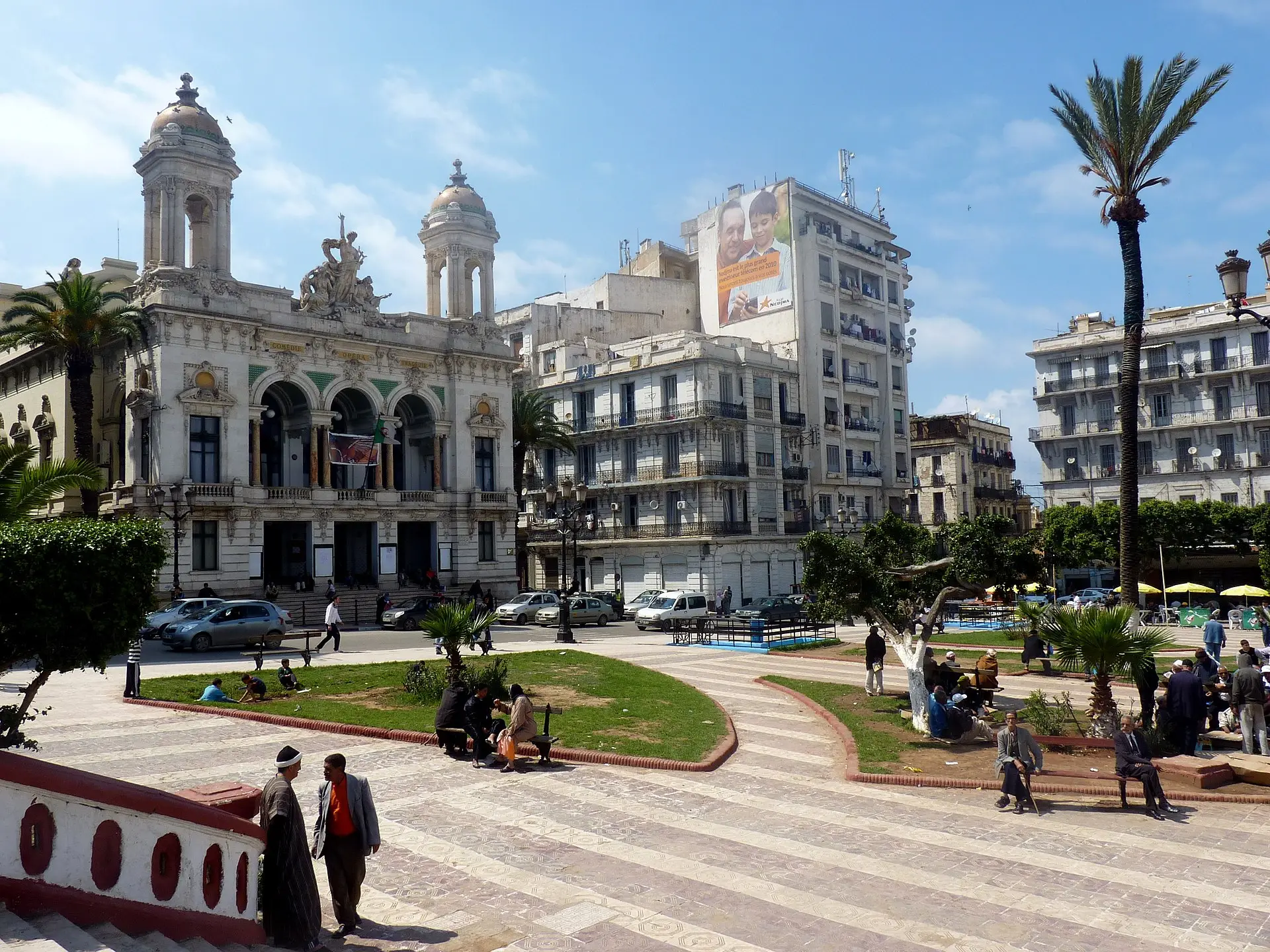
The main square of Oran, renamed after Algeria's revolution but still called "Place des Victoires" or simply "la place" by locals, is the heart of the city's daily life. The grand colonial-era buildings surrounding it — the Opera House (Théâtre Régional d'Oran), the Grand Hôtel, the post office — are testaments to when the French made Oran their second capital of Algeria. Sit at one of the café terraces in the early evening and watch the city stroll past. The art deco facades repay close attention.
Oran's port area and the coastal boulevard have been redeveloped significantly over the past decade. The Boulevard Millénium stretches along the waterfront, lined with palm trees, benches, and the kind of seafront cafés where old men play dominos with impressive dedication. It's a genuine promenade culture here — families, couples, teenagers — all following the Mediterranean evening ritual of being seen while pretending not to care about it.
Oran's old quarter, the Medina Djdida ("New Medina" — the terminology is local and historical), is not as dramatic as Algiers' Casbah but has its own character. The streets around it contain small workshops, spice merchants, fabric sellers, and traditional bakers pulling semolina flatbreads from wood-fired ovens at dawn. The El Hamri quarter to the south was historically one of Oran's most vibrant working-class neighbourhoods and remains a place to eat well cheaply.
Oran's main museum, housed in a beautiful colonial-era building, covers Algerian natural history, archaeology, and fine arts. The archaeological wing has Phoenician, Roman, and Numidian artefacts recovered from sites in the Oran region. The fine arts collection includes 19th and 20th century Algerian and European paintings. It's not a world-class museum but it's free to enter, quiet, and worth two hours.
16th-century Spanish fortress with panoramic bay views. Open daily, small entry fee.
Stunning 1907 colonial opera house. Check for current performances at the box office.
The city's main mosque, converted from a Spanish-era cathedral. Remarkable interior.
The nearest good beach, 35 km west. White sand, clear water, family-friendly.
Oran has some of the best street food in northern Algeria, and a restaurant scene that ranges from working-class neighbourhood spots to surprisingly polished dining rooms. The city's proximity to Spain historically — and its fishing port — gives it a seafood tradition that's more developed than in most Algerian cities.
Chorba: Oran's version of this spiced soup is heavier on tomato and more aromatic than the Algiers variety. Order it at any traditional restaurant, especially in winter.
Grilled seafood: Fresh fish and prawns grilled over charcoal, served with harissa and preserved lemon. The port area has several excellent simple grills where you pick your fish from the display and pay by weight.
Karantika: Oran is the spiritual home of this street food — a warm, eggy chickpea flour pancake served in flatbread with cumin, harissa, and a drizzle of olive oil. You'll smell it before you see it. The best karantika stalls are around the Medina Djdida in the morning.
Mhajeb: Thin semolina flatbreads filled with a spiced tomato and onion mixture, folded and griddled. A perfect mid-morning snack with black coffee.
Local recommendation: For a proper Oranaise family lunch, find a restaurant serving couscous on Fridays. Call ahead — they often sell out by 1 pm. The version with seven vegetables and lamb is the benchmark.
Oran sits on a bay and the surrounding coastline is some of the most beautiful in Algeria, though you need to get out of the city itself to find the good beaches. The following are consistently recommended by locals:
Oran is where Raï was born, and if music means anything to you, this context matters. Raï emerged in the 1920s and 30s from the working-class cafés of Oran's port district — a fusion of Bedouin music, Andalusian poetry, French chanson, and Spanish rhythms. It was explicitly the music of the dispossessed, of lovers, of drinkers and dreamers. The word "raï" means "opinion" or "point of view" in Arabic — these were songs of social commentary, not always welcome to the authorities.
By the 1980s, artists like Khaled, Cheb Mami, and Cheba Fadela had exported Raï globally. Today it's a genre on international stages from Paris to Tokyo. But to hear it in Oran — at a wedding, at a live concert, blasting from a car stereo at midnight on the corniche — is to understand something about it that recordings don't convey.
For live music, ask at your hotel or check local Facebook groups for upcoming concerts. Wedding seasons (spring and autumn especially) are when the best performers play Oran. The city's cafés are generally mixed-gender and relatively lively in the evenings; the corniche area has a decent concentration of places to sit with a coffee or fresh juice and watch the city after dark.
| Topic | Details |
|---|---|
| Getting to Oran | Flights from Algiers (45 min) or Marseille, Paris, Lyon. Trains from Algiers (5–6 hrs). Buses available from most major cities. |
| Airport | Ahmed Ben Bella International Airport (ORN), 12 km from city centre. Taxis available. |
| Getting around | Taxis are affordable and easy to flag down. Tram system covers main east-west axis. Walking works well in the city centre. |
| Best neighbourhoods to stay | City centre (near Place du 1er Novembre) or the Plateau district for easy access to sights. Seafront hotels exist but vary in quality. |
| Safety | Oran is generally safe. Standard urban precautions apply — keep valuables inside, avoid poorly lit areas at night. |
| Best time to visit | April–June or September–October. July–August is hot (35–38°C) and crowded near beaches. Winter (Dec–Feb) is mild and pleasant. |
The "Pearl of the Maghreb" is absolutely worth a day trip or an overnight from Oran. Tlemcen's 12th-century Grand Mosque and the ruins of Mansoura are extraordinary, and the medina is one of Algeria's best-preserved. See our full Tlemcen guide for details.
A smaller coastal city with excellent beaches and a charming Ottoman-era old town. Less visited than it deserves, with some of the best fresh fish restaurants on the Algerian coast. Easy day trip or short overnight.
Driving the coastal road west from Oran toward the Moroccan border (note: the border itself is closed) passes through small fishing villages and some dramatic cliff scenery. Béni Saf, a small port town 110 km west, has pristine beaches that are almost entirely local — you'll be one of very few non-Algerian visitors.
Before or during your visit, immerse yourself in the music that made this city famous. Start with Khaled's "Didi," Cheb Mami's "Meli Meli," and for something deeper, the raw early recordings of Cheba Fadela. Then ask a local what's been playing in the city this year — Raï never stopped evolving.
Oran won't overwhelm you with must-see monuments the way Rome does, and it won't dazzle you with ancient history the way Timgad will. What it does is invite you into a way of life — unhurried, Mediterranean, musical, and genuinely warm toward the rare visitor who shows up curious rather than demanding. Give it two or three days and it will grow on you like a song you heard once and can't stop humming.